Submitted by ADS Member Chris, “Solutions are available to reduce our exposure to harmful and unnecessary microwave radiation.”
News
Dowsing for facts: can a sceptic find science in water witchery?
Linda Geddes, writer for The Guardian website, poses this question in her article dated February 11, 2023.
To find an answer, she explores dowsing with her Mom, a geologist and amateur dowser.
““I was a sceptic too. But dowsing just works,…”
Quote from Isobel, Linda Geddes’ Mom
Linda interviews John Baker, a professional water diviner and archaeological dowser, and Prof Chris French, head of the Anomalistic Psychology Research Unit at Goldsmiths, University of London for their opinions.
To find out what she discovered, read her article.
Memories of Charles Hubbard’s Farm
By: Silvana Castillo
I recently found some pictures that Brian Winstanley took of Charles’ farm in 2015.
Charles hosted many tours at his farm, where the opportunity for collective dowsing was the highlight of the visit. He had created different structures in powerful spots on his land, that would intensify the energies and favour good production of food with high vitality.
These structures include a rock circle with a cross antenna in the centre, a stone circle in the garden with a rose in the centre, a greenhouse inside a pyramid, raised beds using paramagnetic cinder blocks under pyramids, a labyrinth for people, a labyrinth for horses to heal people, a compost pile with the shape of a cross in the crossing of two energy lines.
Inside the house, there were many other things that are not seen in these photos!
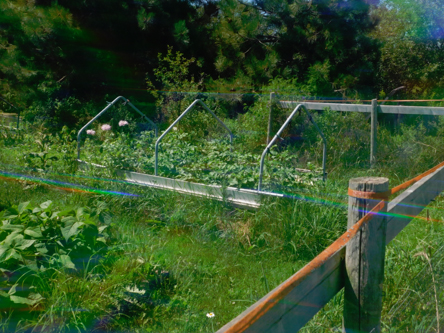
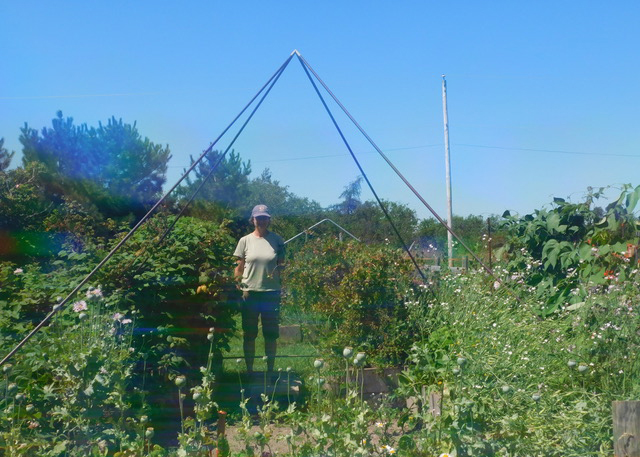
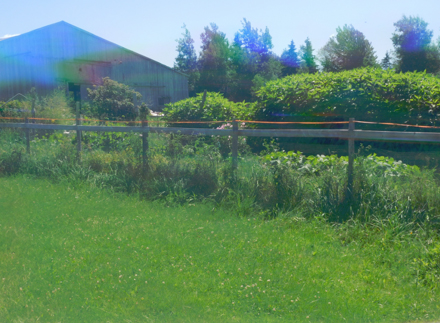
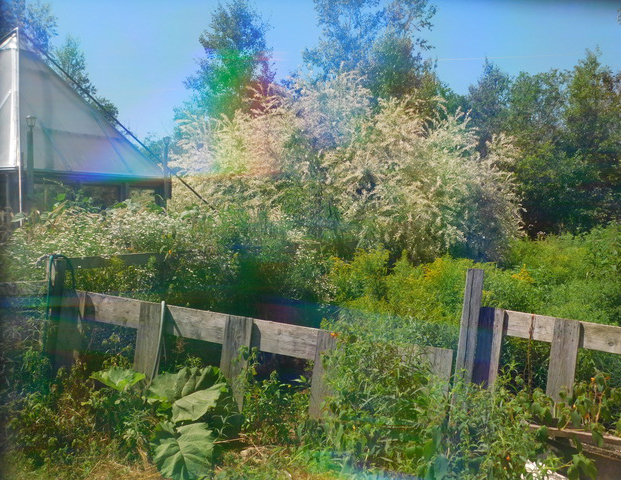
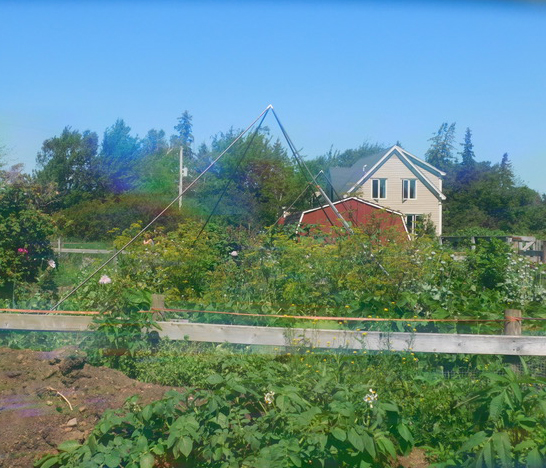
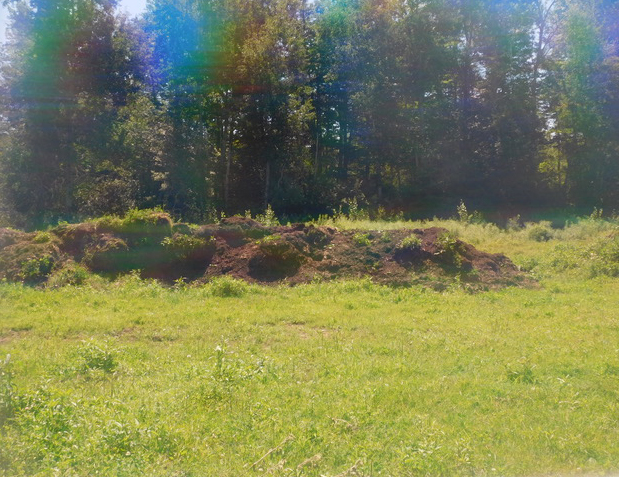
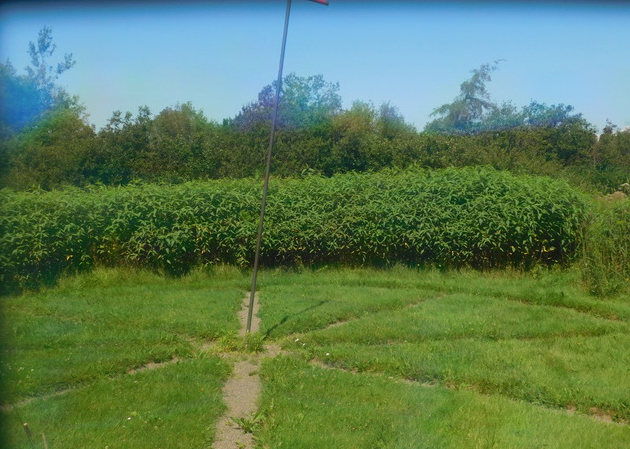
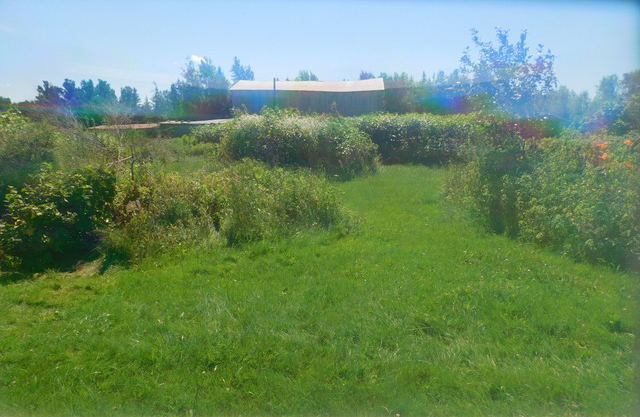
Charles and Brian were always trying to find new ways to prove that energies were present, besides the dowsing rods.
I remember we talked about how to know for sure whether the food we were growing had more vitality. And, in what ways we could show others that working with Nature energies increases food vitality. The Kirlian camera can capture auras and was perfect for showing the energetic body of a living being (such as an apple, for example). Unfortunately, however, it was too expensive.
Later we discovered the refractometer and that was a wonderful tool for measuring food vitality, and it was also valuable in evaluating our soils (the vitality of the food also comes from the vitality of the soil).
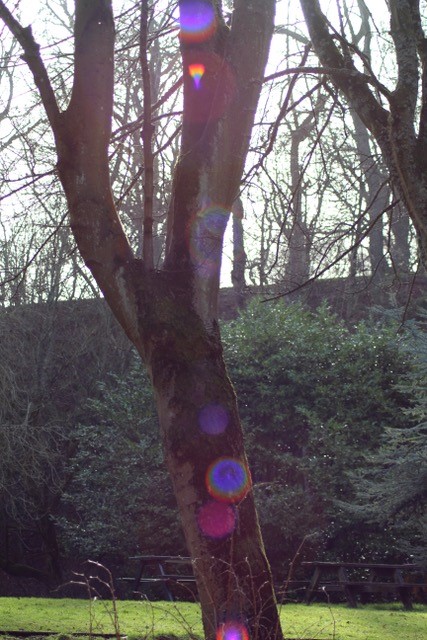
So, at this day of the pictures, Brian had come up with a plastic hard film that would focus on the energies if present, rather than being diffused as a normal lens would do.
Brian also took pictures of Orbs in Scotland, which I am compelled to include one in this blog.
The Dowser
This article by Earl Carter, Empire Press correspondent, dated December 29, 2022, memorializes Richard Viebrock.
I found it a brief but touching look at a dowser’s life. Earl explains how Richard got started, and highlights the importance dowsing played in his life.
The article also has pictures of a statue that stands outside of the Douglas County Museum, in Waterville, Washington.
“Dick Viebrock dowsed and located wells for people all over the Waterville Plateau. In a two-year period, from 1994-1996, his notebook indicates he dowsed 128 wells. And this is not land with an abundance of water.
His notoriety commissioned the memorial statue designed by sculptor Richard Beyer of Pateros. The statue stands on the edge of the Douglas County Museum property. It announces the importance of water to Douglas County residents, but it doesn’t tell the rich story behind the hundreds of wells dug because a dowser said, “Dig it here!””
Earl Carter, Empire Press correspondent
You can find the full article here.
Ley lines: The UK’s mysterious ancient pathways
I came across this interesting article by Bel Jacobs on the BBC website, dated November 2, 2022. The author explores the six day journey, and resulting art, of artist and performer bones tan jones, along some of these ancient roads.
“I’ve always been interested in the opposition between the natural and the artificial, the sacred and the un-sacred,” explains tan jones. “So I decided to walk from the entrance of the Silvertown tunnel… to the monumental stone circle at Stonehenge, and see how I could connect them.”
bones tan jones, Artist and Performer
Bel also explores some of the history of ley lines through the writings of several authors.
“Ley lines? Energy lines? Surely the preserve of myth makers and fairy followers? Not to start with. The term was originally posited, just three years after the end of World War One, by Alfred Watkins, a councillor in rural Herefordshire in the UK. Born in 1855 into a well-to-do farming family, Watkins was also an amateur archaeologist; it was while out riding in 1921 that he looked out over the landscape and noticed what he later described as a grid of straight lines that stood out like “glowing wires all over the surface of the county”, in which churches and standing stones, crossroads and burial mounds, moats and beacon hills, holy wells and old stone crosses, appeared to fall into perfect alignment.”
Author Bel Jacobs
If this has piqued your curiosity, you can find the whole article here.